
What happened when I implemented llms.txt?
I've been a blogger since the early 2000s because blogging is one of my favorite ways to express myself. I like the casual tone where I can share pretty much anything I'm creating at the moment or interested in writing about. So I'm pretty distressed with all the discussion online about how blogging is dead due to the rise of AI.
A month ago I gave into my fear and decided to add llms.txt to my website. This new text file at the site root is basically a sitemap for LLMs. It presents your blog posts in a markdown format that is easy for AI agents to ingest so that they can navigate your site. If people are going to use LLMs rather than search engines, then I want my blog posts to appear there as well.
But how did that change the performance of my blog? How did that change search traffic? How did it change site visitors? How did it change social sharing?
In this post I'm going to share the way traffic to my site changed in the first month since adding llms.txt, then I'm going to use those results to drive a discussion about whether blogging is actually dead or not.
Results of adding llms.txt
I added llms.txt to my static eleventy blog on October, 5, 2026. The pattern of traffic to my site changed almost immediately. Here's a screenshot from Google Search console that compares the first month of search traffic with llms.txt against the last month of search traffic with no llms.txt.
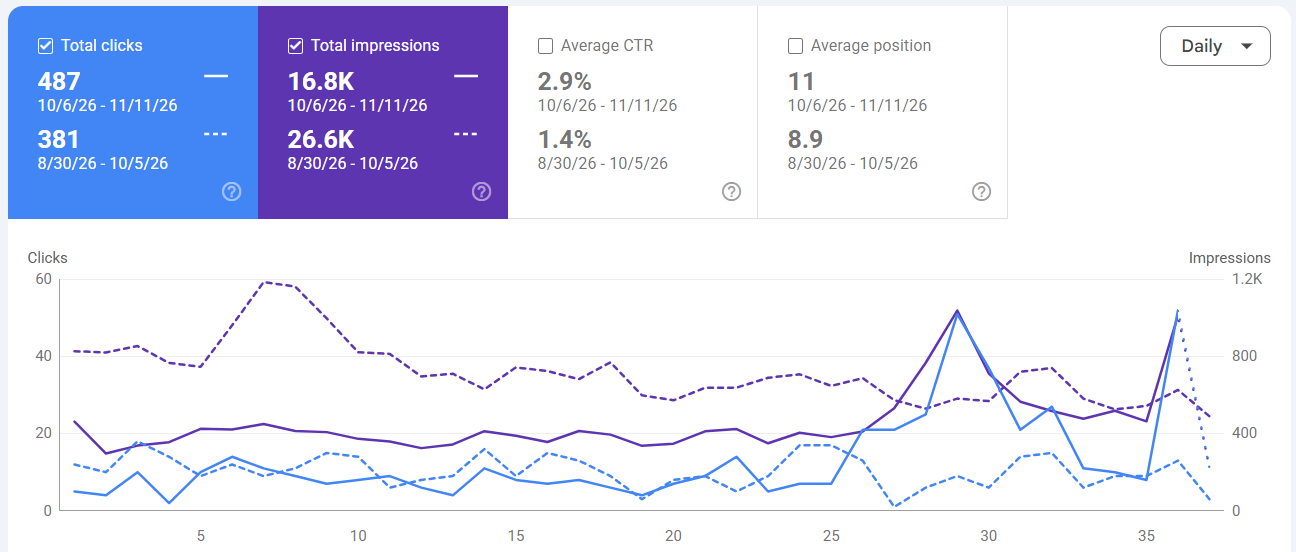
The results are crystal clear. Impressions went way down. Clicks went way up. In the month after adding llms.txt I had 16.8k search impressions, while in the month prior I had 26.6k search impressions. That's a huge change! I lost nearly 10k impressions because I added llms.txt! This may seem awful at first, but it's balanced out by a change in clicks. In the month since adding llms.txt I've had 487 clicks, while in the month prior I had only 381. This means I'm getting more visitors to my site even though I'm appearing in Google search results less frequently.
When we look at pageviews, the story is a little more confusing. Here's what Google Analytics shows for my pageviews.
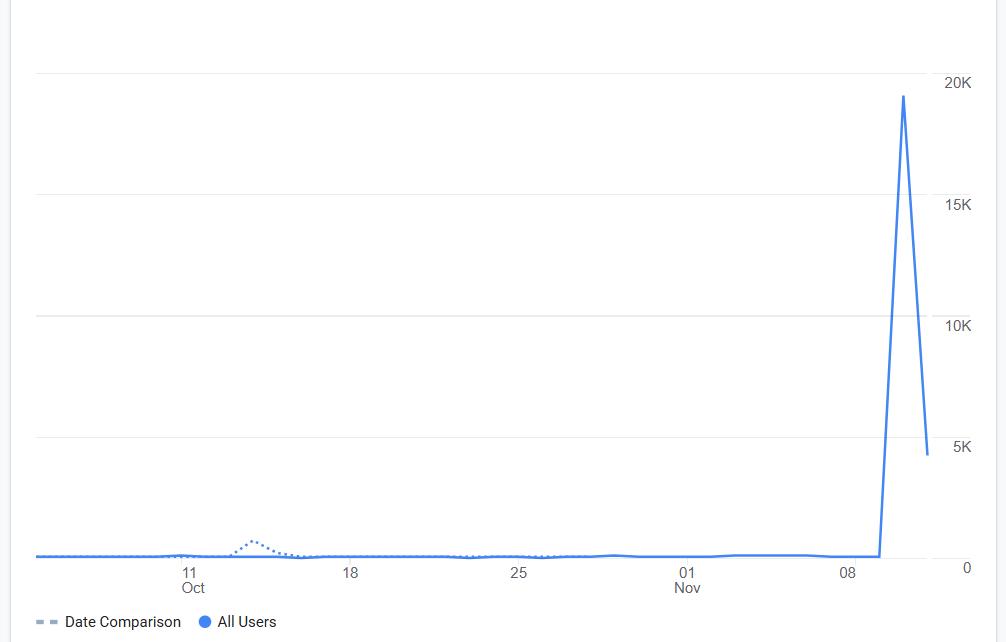
The lines before and after the change are difficult to read at this scale due to the spike at the end. The only significant difference is that there is a massive spike in pageviews later in the month after adding llms.txt. When we dig into the traffic source, we see that that is coming from social media.
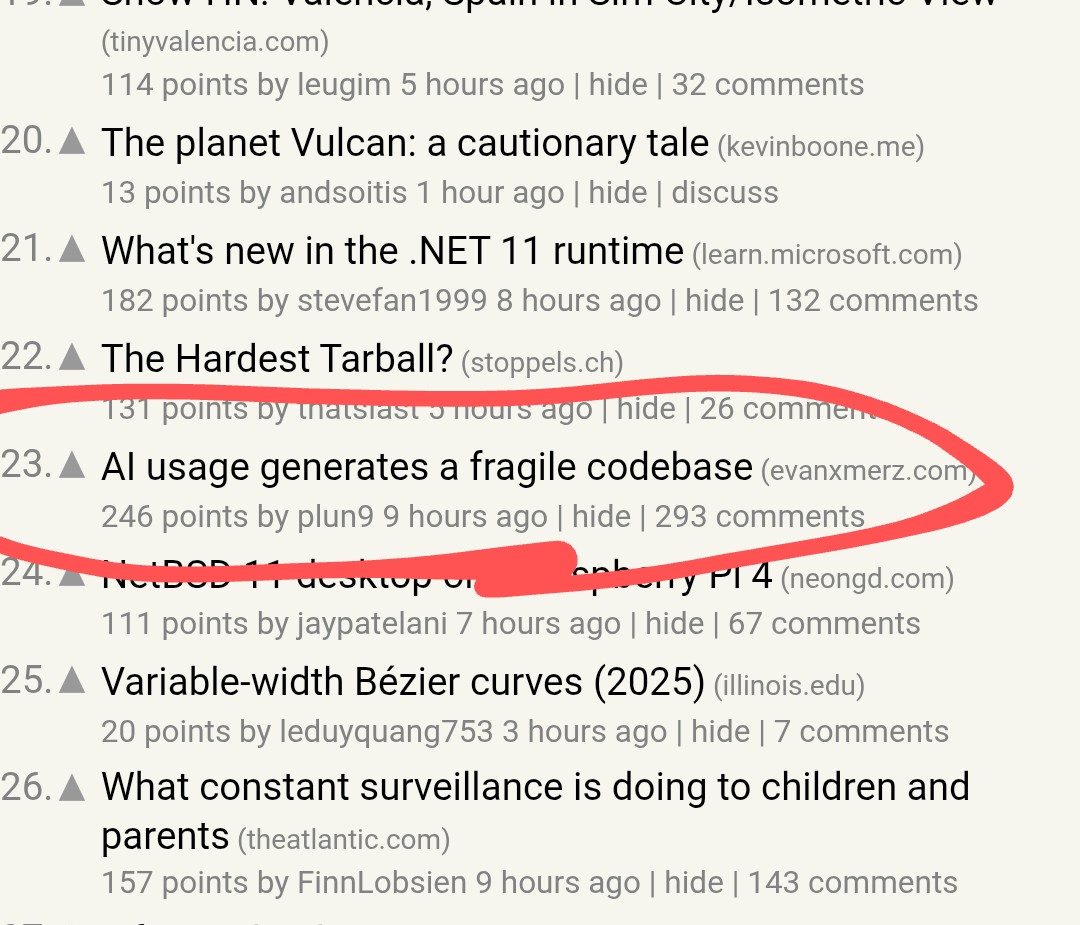
Well, it turns out that someone found one of my recent blog posts about the fragility of agentic codebases and shared it on Hacker News. In fact, one of my coworkers reached out to me to inform me that it was on the front page of Hacker News. The highest I saw it was link number 22, but I was pretty happy to see one of my articles gaining traction because that happens so rarely.
Blogging is even more important in the age of AI
The results of adding llms.txt to my site are pretty clear. After adding llms.txt my site saw more visitors from search and from social media. One of my posts went about as viral as a blog post can go. Adding llms.txt to my site has been a great boost to traffic.
It seems like a lot of people really are using AI chat to find content on the web. After all, I didn't share that blog post to Hacker News. Someone discovered it by chatting with AI, shared it to Hacker News, and then it climbed the ranks. That resulted in more traffic than my blog has seen in years.
So is blogging dead because people are using chat bots? No. Quite the opposite.
Chatbots need sources and references in order to be able to talk about anything. The sources that they need can't be generic, low quality AI slop. They need to find authoritative articles written by people with strong non-AI voices. In order for AI chatbots to present good answers to readers, AI chatbots have to be able to find good writers and leverage their writing in the response.
As long as the chatbots are citing sources, then this should result in increased traffic to the creators who are sharing good content on the internet. Chatbots are a net positive thing writers.
In fact, I think that AI is separating the wheat from the chaff. I think AI is putting a spotlight on the people who are making the highest quality content. Why is that?
People who don't like writing are now using AI to do their writing. They were never good writers, and their skills are decaying because they're offloading their work to AI. People who like writing are still writing by hand. They are still honing their craft. The difference between the two groups is growing more and more stark, and AI can see it. AI isn't linking to other AI slop. It's linking to the best work.
I don't think this is unique to writing either. I think we are seeing this happen in all fields impacted by AI. The bad programmers are becoming worse. The good programmers continue to separate from the pack. The lazy artists are generating slop with AI, while the most skilled artisans stand out even more.
In short, AI usage is a net benefit to those who really enjoy what they are doing. It's a net positive for my blog since adding llms.txt, and I suspect it's a net positive to any other creator who is doing high quality work.
The impacts on the lower end of the market are less clear, and may be less positive. The lowest paid art work is probably going to AI now. The lowest paid writing work is probably also going to AI. Is AI benefiting the people at the bottom? Probably not, but I don't have data that reflects that.
So for now I'm going to keep blogging. In fact, I'm going to redouble my efforts to bring traffic to my site using AI. I am glad that there is a new traffic source beyond search and social media.
Jensen Huang is not the first victim of spying in tech
Everyone on the planet seems to think that Jensen Huang is some kind of fool for falling for a Chinese spy. Huang's story is embarrassing, but it's hardly new. Huang is just the latest victim of international spycraft in American tech.
Here's a reminder of some of the other times when spies infiltrated Silicon Valley.
1. Linwei Ding at Google
Linwei Ding was an AI engineer at Google. Between May 2022 and April 2023 he stole more than 2,000 pages of confidential AI trade secrets and uploaded them to a personal cloud account. A jury in January 2026 convicted him on seven counts of economic espionage and seven counts of trade-secret theft. Later, a judge threw out the economic-espionage counts, saying there was not enough evidence Ding knew or intended his conduct to benefit the Chinese government, but left the trade-secret convictions standing.
2. Xiaolang Zhang at Apple
Apple's secret car project, Project Titan, was supposed to be locked down. Then Xiaolang Zhang, a hardware engineer on the project, allegedly downloaded a 25-page circuit-board schematic for a self-driving car, plus manuals and prototype material, before trying to leave for Chinese EV startup XPeng. Apple flagged the activity, alerted the FBI, and Zhang was stopped at San Jose airport before boarding a last-minute flight to China. He later pled guilty to theft of trade secrets.
3. Abdulrahman Alfozan at OpenAI
In September 2026, OpenAI staff found a recording device plugged into the back of a TV in an executive conference room, wrapped in toilet paper to hide it. The FBI arrested Abdulrahman Alfozan, a 35-year-old Saudi national who had joined OpenAI in July 2025. Prosecutors allege he planted the device to capture sensitive conversations, and that he used an internal tool to figure out when and where executives were meeting. He pled not guilty, and the FBI has explored whether to add an economic-espionage charge.
4. Yanjun Xu at GE
Yanjun Xu, a career officer in China's Ministry of State Security, was convicted in 2021 of trying to steal aviation trade secrets, including technology related to GE Aviation's composite engine fan module. Prosecutors said he used aliases, front companies, and university invitations to recruit aviation employees, pay their travel, and then ask for proprietary files. He was sentenced to 20 years in prison in 2022, the first Chinese intelligence officer ever extradited to the U.S. to stand trial.

Why is Silicon Valley a target for spycraft?
Washington is where government secrets live. Spies target the US government if they want to know what the government knows. Silicon Valley is where the future gets built. Spies target American tech because they want to know what is coming and sell it to the highest bidder.
Each year, Silicon Valley becomes a bigger target for international espionage, and the intelligence world has been saying this for years. In October 2023, the spy chiefs of the U.S., Britain, Australia, Canada, and New Zealand met at Stanford and warned that China's espionage had shifted from government buildings in Washington to innovation hubs in the Bay Area. They said Beijing was especially interested in AI and urged private companies to protect their intellectual property.
FBI officials have estimated that more than half of Chinese espionage focused on stealing American technology takes place in the Bay Area. And one former intelligence official told journalist Zach Dorfman that at one point, a full 20 percent of all the FBI's active counterintelligence-related intellectual-property cases had originated in the Bay Area.
Silicon Valley also makes the job easier. The culture is open by design. People job-hop. People share. Startups brag about what they are building to raise money. Engineers go to the same conferences, the same coffee shops, the same meetups. A stranger asking smart questions does not stand out, because asking smart questions is the whole vibe.
Not to mention the fact that us nerdy engineer types are easy targets. Most of us are lonely guys on the spectrum. It's not that difficult for a pretty girl to show the smallest bit of interest in us and get whatever she wants.
So, was Huang naive, or was he just part of an ongoing attack on American innovation?
Nvidia said Huang's interactions with Alice Huang were not unusual, that meetings with customers are part of a CEO's job, and that regional cloud customers get ordinary business information, not sensitive trade secrets, but that sounds a lot like double-speak to me. Espionage is rarely about one meeting where someone hands over the crown jewels. It is about learning what the CEO cares about, what he is trying to get done, who he trusts, and what is coming next. A person close to the CEO does not need a smoking gun to do their job.
Jensen Huang isn't the first powerful tech executive to be targeted. He won't be the last. He is just the latest in a long line that includes engineers at Google and Apple, OpenAI, GE, IBM, and more.
AI usage generates a fragile codebase
I can only speculate as to the reasons why I was laid off from Meta in May, but I suspect that one of the reasons is that I was a little bit more resistant to adopting AI/LLMs as coding tools than some of my peers. Don't get me wrong, I generated at least 90% of my code using AI in my last few months there, which was the minimum for a decent rating. But AI didn't 10X the amount of code I was writing. It didn't even 2X it.
I was focused on code quality. I saw the code being pushed by some of my peers who were heavily reliant on AI, and I saw that it was brittle code. There were many subtle issues that would lead to tech debt in the long term, and even some glaring issues were ignored by very good programmers. For instance, I saw one of the best programmers on my team try to merge code that used javascript events for mouseover CSS effects rather than using the :hover selector, which is a totally unscalable way of writing mouseovers.
Now I'm employed at another large tech company and I've fully made the switch to generating 100% of my code using AI because that's the expectation today. Still, I can see lots of people becoming aware that this isn't a sustainable way to continue development of a large scale SaaS product. AI tends to solve the problems that can fit within its context window very well, but it's totally oblivious to the long term issues that can't be understood in that relatively small frame.
In this post I'm going to list four ways that AI usage results in a fragile codebase that isn't resilient to the demands of highly available and highly scalable SaaS applications.
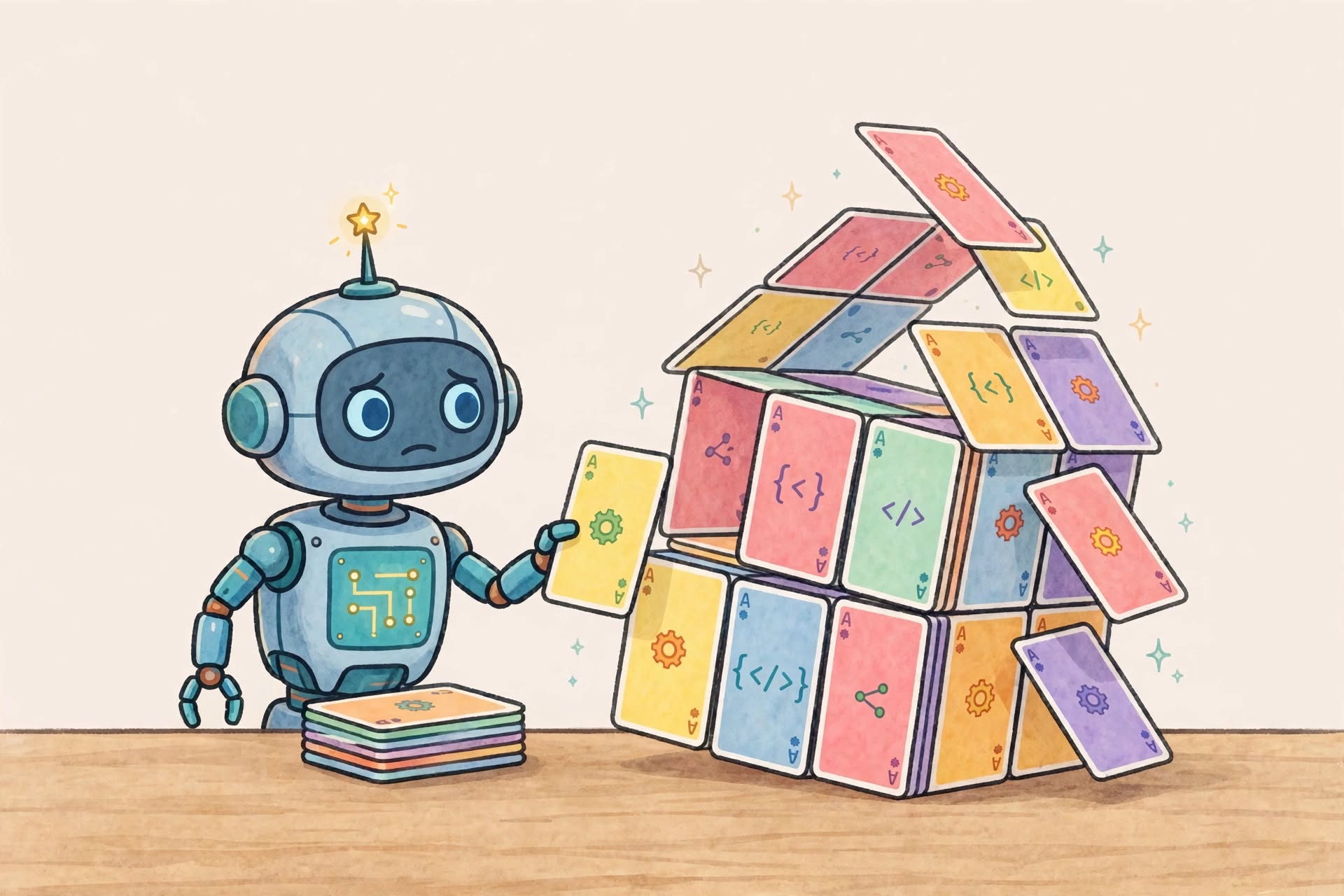
By the way, every word of this article was written by a human. Even though the following image was generated by AI, this article isn't AI slop.
Four ways AI makes codebases fragile
Here are the four most common ways that I have seen AI generating a fragile codebase.
1. AI writes shallow tests
One of the most obvious failures of modern LLMs is that they tend to write simplistic automated test cases that don't cover the things that matter to humans. Frequently I see AI agents writing lots of tests of get/set methods which are trivial and don't typically require much testing. When AI writes e2e tests, they tend to only cover the cases which are already covered in the codebase. In other words, the AI writes tests only covering one type of user, or only covering surface level interactions. This creates massive gaps in the test coverage that are invisible to developers because they aren't captured by the line level coverage metric.
2. AI writes overly complex ccode
AI also tends to write overly complex code. It frequently uses two or three helper methods when a single one would suffice. It tries to follow coding guidelines, such as DRY, to a fault, without realizing that the added complexity of that rigidity makes the code more difficult for human developers to debug or understand.
3. Reliance on AI decreases human understanding
And that's the third issue with AI codebases: Humans don't understand them. The longer a company relies on AI agents to generate the code, the fewer developers are going to understand the codebase. This means that developers can't do the things that are necessary to build a resilient codebase. They don't understand the data structures and algorithms well enough to see when a pull request contains a new abstraction that doesn't work with the pre-existing structures.
4. AI moves too quickly to maintain a high quality bar
AI moves too quickly for human developers to maintain a high quality bar. Each pull request comes faster than the prior one and has to be reviewed in even less time. This leads to developers skimming the code and missing crucial details that result in long term tech debt. Small quality issues like testing gaps and poorly named variables accrue in the codebase until it becomes a morass of spaghetti code.
Four signs that you have a fragile codebase
If you're unsure whether coding agents are harming your codebase or not, then you might look for the following symptoms of a fragile, AI-generated codebase.
1. AI generated codebases have more incidents
When you switched the department over to agentic coding did the number of incidents slowly start rising? At first when we were all using agents to generate massive amounts of code, it didn't seem that different from traditional coding. The PRs came and were merged and everything seemed alright. But oh, there was that one p0 that came in at the end of the month, then there were two SEVs the following month. Then even more the next month. Now, after a year or two of agentic coding, it seems like there's an incident every weekend. AI coding agents are the reason why there are more incidents impacting customers.
2. Recovery from incidents takes longer in AI codebases
Not only are there more incidents, but the incidents take longer to be mitigated. The fact is that the human developers on your team now have a more shallow understanding of the codebase. If your coding agent can't find the issue that your customers are facing, then humans are going to have to dig through a codebase that is highly complex and poorly tested. They will essentially be entering unfamiliar territory, so it takes longer for them to figure out what is going wrong. Hence, companies lose more and more money to incidents that take longer to resolve.
3. AI generated codebases create errors that are only visible to users
When humans don't spend time in the code, they fail to see all of the use cases. They fail to understand how actual humans are using the code because they aren't ensuring that the AI is instrumenting analytics and catching all the errors properly. Hence, invisible errors start appearing in the codebase. Errors are uncaught and only visible to real world users, as opposed to the types of users that are being tested in automated tests or in developer manual testing.
4. AI results in a poor user experience
And that leads to the ultimate problem with AI codebases: they weren't made for humans. AI codebases are software made by AI for AI. They aren't being tailored to the way that human users use the product, and they aren't being tailored for the way human developers need to maintain the product. The experience degrades on both the user and the developer side, leading to a vicious cycle of enshittification.
Products made for humans require a human touch
The fact of the matter is that for a product to satisfy human customers, it has to be informed by a human perspective. Nobody likes ordering from machines at a restaurant. Shopping for clothes from a website always results in worse fits than shopping in person. The same is true of SaaS products. Any time you leave your SaaS product in the hands of a machine, you are losing the human touch that is valuable to your users and your developers. This may work for the cheapest products that only compete on price, but high quality software products will continue to have a human touch. The best, most expensive products will be tailored for human users by human developers. They will be charming and enjoyable to use. They won't be fragile because they won't be primarily developed by AI.
Being a liberal man can be trying at times
My wife went into labor on a Wednesday afternoon. When I found out about it at 3pm, I immediately left work to pick up our daughter from daycare. I was working in the videogame industry at the time, which is incredibly abusive to its captive labor market of young gamers. The head of that now-defunct games company insisted we all work ten hour days, so I had only worked from 7am to 3pm that day. After the birth of my second child, I took two vacation days on Thursday and Friday.
ASIDE: I might have been eligible for some paternity leave under some laws, even at a small company, but the company didn't offer me anything or give me a mechanism for applying for paternity leave, so I was totally unaware of that possibility, and there was a lot of social pressure against taking any leave at all.
When I returned to work on Monday, my boss called me into his office (when he finally arrived at 10am). He had a new contract on his desk that he wanted me to sign. He told me directly that "since I was missing so much time" it was only fair that I was moved from salaried pay to hourly pay. Essentially he wanted to lower my pay because I took two days off for the birth of my child.
Obviously I didn't sign the contract and I immediately began looking for another job. I found one quickly, and moved to a new company, but this wasn't a blessing either. I then had a newborn baby, a toddler, and a brand new job all at the same time.
I was sleeping 45 to 90 minutes every night. For the first week of the new job I had the flu, and it was obvious. But I had no sick time accrued, so I had to work.
I didn't get much more sleep for the next two or three years. My partner refused to let the kids cry it out, so they never learned to self soothe. She had maternity leave, of course, but I didn't get anything from the startups I was working for at the time. So I had to go to work sick and sleep deprived for years.
It was awful.
One Monday I came into the office bleary eyed and groggy. My head was sore, my sinuses were swollen and I was exhausted on every level. I went to get coffee and ran into a coworker who we will call Sam. We only had a very brief conversation. It went something like this.
Me: How was your weekend?
Sam: Pretty good. I mostly just played videogames and hung out.
Me: That sounds nice.
Sam: How was your weekend?
Me: Oh I barely got any sleep or rest. I wish I had some paternity leave.
And that was pretty much it. There might have been an additional sentence or two, but it was the type of standard, perfunctory conversation that is commonly experienced on a Monday morning at work.
The next day when I sat down at the company's shared lunch table I was absolutely blind-sided by the conversation. I was so stunned by the conversation that I can't recall the exact words that were exchanged.
As I was sitting down, Sam brought up our conversation from the prior morning. Sam told the entire workforce that I was a men's rights activist and a member of the alt right. I think Sam intended it as kind of a funny conversation starter, but before I unpacked my lunch the word "neo-nazi" was said about me by one of my coworkers.
I remember sitting there in a daze with words flying around me that I didn't have enough time to ingest let alone respond to. Everyone was talking about my politics without caring about my perspective or the complexity of the issues involved.
Before I knew what was happening, everyone was looking at me, expecting me to defend myself against the accusation that... because I thought men deserved time off when their kids were born, I must be a men's rights activist, which made me alt-right, which in turn made me a neo-nazi.
Now at that point I had only lived in California for around six years. We moved out here from Pennsylvania for school and work, but we stayed because we liked the liberal milieu. We liked the liberal politics, and the diverse neighborhoods. We wanted to raise our children in a place that cared more about parks than about professional sports.
I myself was a committed liberal. I phone banked for Obama, donated hugely to the Democrats, walked in multiple pride parades, and campaigned for clean energy.
So this was a shocking, and offensive turn of events. It has prevented me from speaking about politics in public for a decade because I was scared of losing my job or derailing my career.
In fact I've never publicly written about this experience under my own name. It was a really difficult time for me, and whenever I bring up the issues that have impacted my life, I get a similar response to the one I got at work that day. People tell me that, as a straight white man, talking about the issues I face is somehow wrong or hateful, and they make the conversation about their own group.
I'm talking about this now because I'm still, somehow, a committed liberal. I know that climate change is the most important issue facing our country and our species. Since the Republicans are a wholly owned subsidiary of the obsolete fossil fuel industry, I can't possibly vote for them.
But the Democrats are busy trying to lose the upcoming election anyway.
They've searched for reasons why men are shifting right and they've come up with all the usual nonsense that avoids any actual introspection. I've read dozens of op-eds in major newspapers that treat men as inherently problematic, and explain how misogyny and toxic masculinity are the problems. They blame the "manosphere", which is slang for the convenient scapegoats of the media and men themselves. They blame messaging and suggest that going on the podcasts that men listen to will somehow turn things around. And Pete Buttigieg grew a beard, which is apparently okay now.
Democrats will do anything except acknowledge that men are just a typical constituency who want policy that improves their lives. Men are facing huge gaps in education, healthcare, parental rights, job access, and more. There are dozens of ways that Democrats could support policy that would help men.
So let's take a quick look at the California Democrat platform as of October 14th, 2026. It's less than a month until the election, and the Democrats have been trying to court men. I'm curious about what they've put in the platform to help men...
Wow, there are a whopping 23 subheadings on this platform! The Democrats clearly care about a wide range of people, issues, and constituencies. There's a subheading for Children and Families. There's one for Seniors. There are subheadings for Women, Young Adults, Immigration, and whatever "Rural" is.
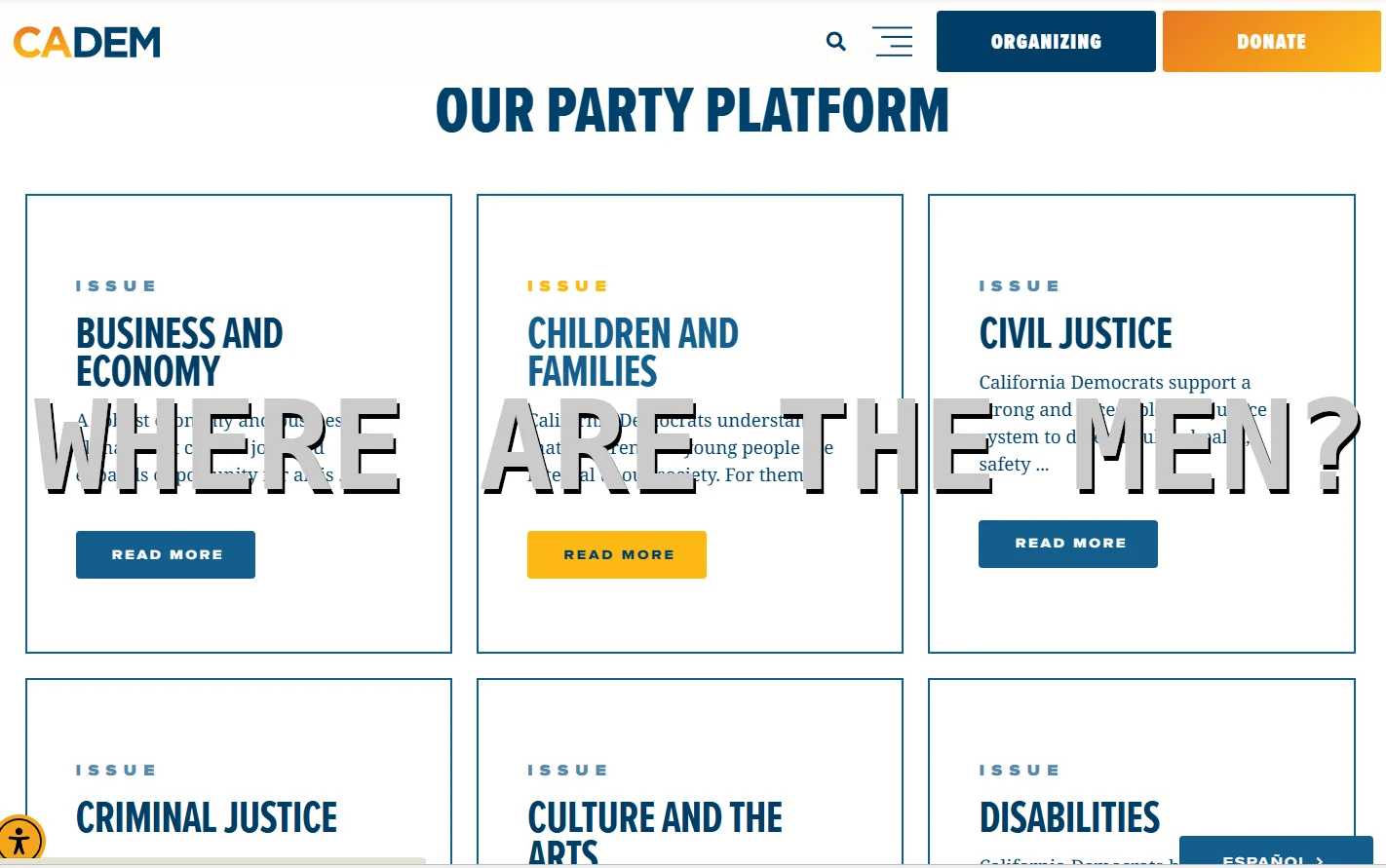
But there's one constituency that doesn't appear a single time on this platform. If you guessed men, then don't tear a ligament trying to pat yourself on the back. After decades hearing nothing but negativity about men from the left, we know there's no spot for us there. I didn't seriously think there would be.
For Democrats to acknowledge that men are just regular voters is impossible. The Democrats would rather believe that men are motivated by misogyny or the scary manosphere or whatever other boogeyman they invent. They want to continue throwing around gender based stereotypes like tech bro, gym bro, incel, performative male, or some other word salad.
Because if they acknowledge that men are just normal voters who, like any other constituency, just want a government that represents their interests, then it flies in the face of two decades of Democrat rhetoric about toxic masculinity, male privilege, and misogyny. For them to treat us like regular people is to acknowledge the abuse and hate that they have supported for years.
Some people expect a blue wave in 2026.
It's hard for me to believe that Trump and the Republicans can continue winning when they do nothing but destroy the economy and the environment.
But it's a month before the election, and the California Democrat platform doesn't use the word "men" even once.
NOTE: Brothers, you are entitled to eight weeks of paternity leave in California. Don't let your employers mistreat you like I did just because of social pressure.
Backrooms: Is it possible to escape the capitalist labyrinth?
Last night was my third night alone here at our new cabin in the Pacific Coast Ranges. I'm here doing some DIY to get the cabin into shape. It has been lovely to spend some time utterly alone in the mountains, hearing nothing at night except the sound of the wind in the trees. It's certainly a good break from my hectic life in Silicon Valley.
As I settled into bed in the pitch darkness of the woods, I decided to watch one of the A24 releases that I missed earlier this year, Backrooms. After watching the cold open I realized that I would never get to sleep if I continued, so I put it away until I could finish it at lunch time today.
Backrooms really resonated with me. It resonated with me in multiple ways. Maybe a great movie resonates in a different way with every audience member, but I feel like it spoke to a lot of the issues that I've been struggling with lately.
And before I go on, I should say that I'm not going to deal with the extended universe of Backrooms that exists outside the movie. I was unaware of that material going into the movie, and I want to consider the movie as a standalone experience for now.
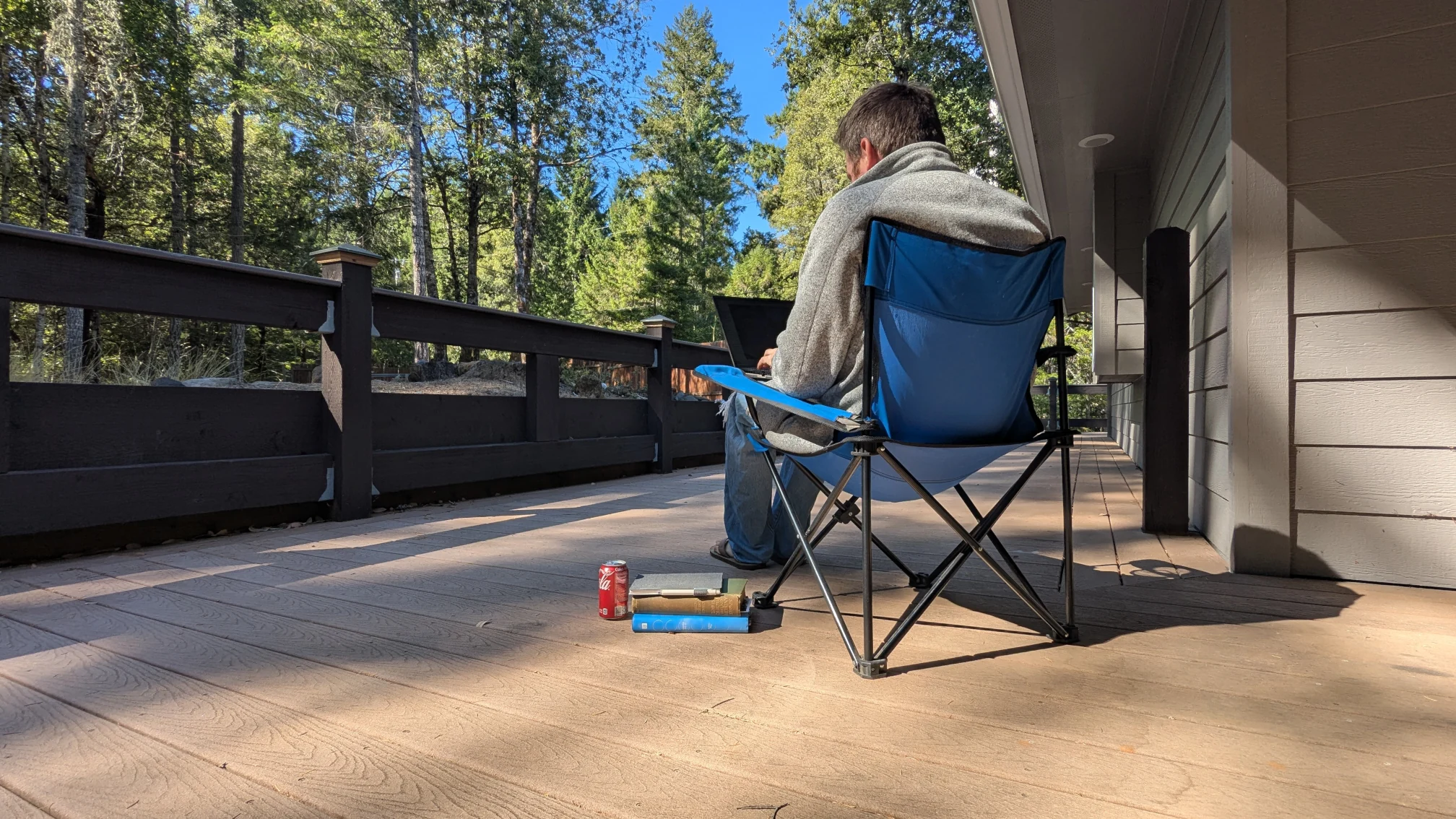
The setting of Backrooms is an uncanny version of Silicon Valley in 1990 that has all the style of 1990, but all of the capitalist anxiety of the 2020s. It features a man who is drawn into a parallel universe that mirrors a distorted version of his own reality. It then tells a story that is a reimagining of Theseus and the Minotaur, but with all the trappings of the setting.
The setting felt so personal to me. Not just because I live and work in Silicon Valley, at the heart of the machine that powers our grimly capitalist society, but also because I was alive in 1990. I was 8 and 9 years old in 1990 and I got sick a lot at that time. My parents couldn't always afford to take sick days to take care of me, so I was often left to explore the empty parts of the office buildings in which they worked. I remember the dark scary rooms with dusty drop ceilings that seemed repellant to all life. When I saw them again in Backrooms I immediately felt the fear and anxiety that director Kane Parsons was channeling: the fear and anxiety of being lost in a massive world that isn't fiendly to your presence.
But it wasn't just the setting of Backrooms, it was also the transmutation of capitalism into a brutal maze that is impossible to conquer, understand, or even escape. I'm not sure if it's what Parsons intended when he made the film, but this embodiment of capitalism as a maze and a monster is the most tangible depiction of our society that I've ever experienced on film.
Because capitalism is a game that humanity invented only 500 years ago, and now we can't escape it. Now we're stuck inside it fighting monsters of our own invention, much like Clark gets stuck in his own back rooms.
The way he was drawn into the labyrinth felt so real to me. He was struggling with so many issues in his life. He wanted a family and a comfortable life, but the only way he could get those things was by participating in capitalism in a way that he didn't want to. He set out to be an architect and make beautiful buildings, but in middle age he found himself selling furniture to support a partner who didn't appreciate him.
And then a mysterious door opened up in his basement. Why not enter it? Why not explore? His life offered him little fulfillment. His partner was building the career she wanted on his dime, but he was stuck doing the hard work that made it possible. What did he have to lose?
But that attitude only drew him deeper into the labyrinth until the climax, when we saw him living comfortably within it, at peace with the monsters that lived there.
His journey felt so relatable to me. Twenty years ago I wanted to be a musician or make videogames. My music career ended in alcoholism for my bandmates and two semi-useless degrees. When I worked, briefly, in the videogame industry I found that the brutal working conditions outweighed any enjoyment I might have gotten from being there. So I ended up in big tech, working in social media and ecommerce. I was drawn further into the maze. As the voice on the self help tape asks Clark halfway through the movie, "why did you do this to yourself?"
I also related to all the ways that the characters tried to escape the labyrinth. Every way out was an illusion. Each new door only led to more rooms with more uncanny representations of office building despair. This reminded me of all the ways that we try to escape our lives within capitalism by making enough money that we no longer have to work. One of my friends tells me that she's only working her high paying corporate job as a means to an end. Another friend of mine bought houses in Buffalo and became a landlord. I chose to buy this cabin in the woods, and spend my weekends cosplaying as a survivalist.
All three of us are trying to escape the capitalist labyrinth, but in a significant way we were only drawn deeper into the labyrinth. My friend who continues the corporate grind will have spent most of her life in offices like those in Backrooms by the time she retires. My friend who became a landlord chose to become the Minotaur; he became the beast that drives us all. And this cabin will cost me an arm and a leg just to kindle the illusion that I can escape.
A horror movie like Backrooms can be weirdly comforting. Not because it isn't scary; I was certainly holding my breath at several points in the movie. But it's comforting because it's so relatable. It reminds me that I'm not going through all of this alone. Whether the director intended the bleak capitalist symbolism or not, it made me feel seen.