
Backrooms: Is it possible to escape the capitalist labyrinth?
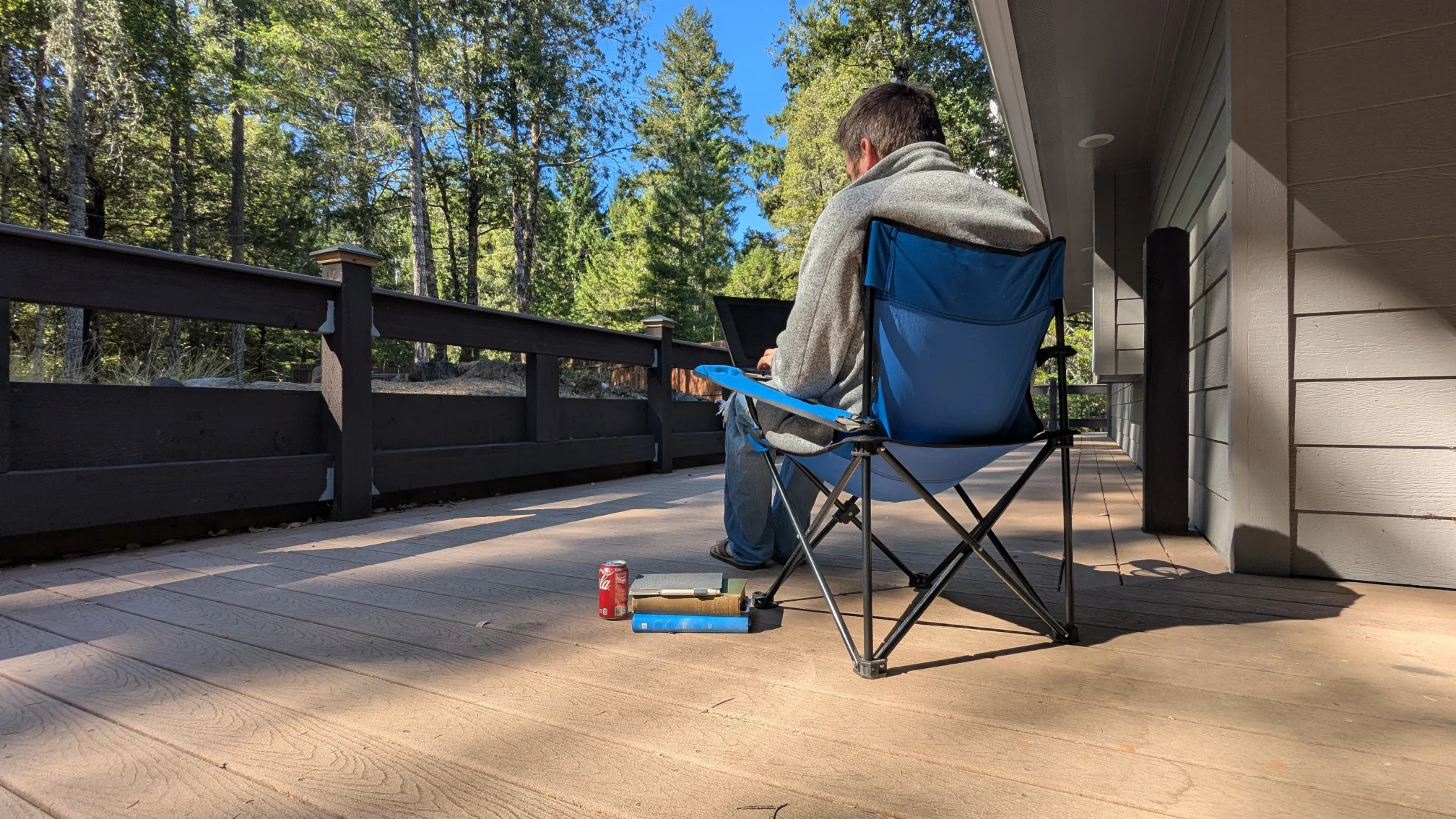
Last night was my third night alone here at our new cabin in the Pacific Coast Ranges. I'm here doing some DIY to get the cabin into shape. It has been lovely to spend some time utterly alone in the mountains, hearing nothing at night except the sound of the wind in the trees. It's certainly a good break from my hectic life in Silicon Valley.
As I settled into bed in the pitch darkness of the woods, I decided to watch one of the A24 releases that I missed earlier this year, Backrooms. After watching the cold open I realized that I would never get to sleep if I continued, so I put it away until I could finish it at lunch time today.
Backrooms really resonated with me. It resonated with me in multiple ways. Maybe a great movie resonates in a different way with every audience member, but I feel like it spoke to a lot of the issues that I've been struggling with lately.
And before I go on, I should say that I'm not going to deal with the extended universe of Backrooms that exists outside the movie. I was unaware of that material going into the movie, and I want to consider the movie as a standalone experience for now.
The setting of Backrooms is an uncanny version of Silicon Valley in 1990 that has all the style of 1990, but all of the capitalist anxiety of the 2020s. It features a man who is drawn into a parallel universe that mirrors a distorted version of his own reality. It then tells a story that is a reimagining of Theseus and the Minotaur, but with all the trappings of the setting.
The setting felt so personal to me. Not just because I live and work in Silicon Valley, at the heart of the machine that powers our grimly capitalist society, but also because I was alive in 1990. I was 8 and 9 years old in 1990 and I got sick a lot at that time. My parents couldn't always affort to take sick days to take care of me, so I was often left to explore the empty parts of the office buildings in which they worked. I remember the dark scary rooms with dusty drop ceilings that seemed repellant to all life. When I saw them again in Backrooms I immediately felt the fear and anxiety that director Kane Parsons was channeling: the fear and anxiety of being lost in a massive world that isn't fiendly to your presence.
But it wasn't just the setting of Backrooms, it was also the transmutation of capitalism into a brutal maze that is impossible to conquer, understand, or even escape. I'm not sure if it's what Parsons intended when he made the film, but this embodiment of capitalism as a maze and a monster is the most tangible depiction of our society that I've ever experienced on film.
Because capitalism is a game that humanity invented only 500 years ago, and now we can't escape it. Now we're stuck inside it fighting monsters of our own invention, much like Clark gets stuck in his own back rooms.
The way he was drawn into the labyrinth felt so real to me. He was struggling with so many issues in his life. He wanted a family and a comfortable life, but the only way he could get those things was by participating in capitalism in a way that he didn't want to. He set out to be an architect and make beautiful buildings, but in middle age he found himself selling furniture to support a partner who didn't appreciate him.
He was already participating in capitalism in a way that he never set out to, and then a mysterious door opened up in his basement. And why not enter it? Why not explore? His life offered him little fulfillment. His partner was building the career she wanted on his dime, but he was stuck doing the hard work that made it possible. What did he have to lose?
But that attitude only drew him deeper into the labyrinth until the climax, when we saw him living comfortably within it, at peace with the monsters that lived there.
His journey felt so relatable to me. Twenty years ago I wanted to be a musician or make videogames. My music career ended in alcoholism for my bandmates and two semi-useless degrees. When I worked, briefly, in the videogame industry I found that the brutal working conditions outweighed any enjoyment I might have gotten from being there. So I ended up in big tech, working in social media and ecommerce. I was drawn further into the maze. As the voice on the self help tape asks Clark halfway through the movie, "why did you do this to yourself?"
I also related to all the ways that the characters tried to escape the labyrinth. Every way out was an illusion. Each new door only led to more rooms with more uncanny representations of office building despair. This reminded me of all the ways that we try to escape our lives within capitalism by making enough money that we no longer have to work. One of my friends tells me that she's only working her high paying corporate job as a means to an end. Another friend of mine bought houses in Buffalo and became a landlord. I chose to buy this cabin in the woods, and spend my weekends cosplaying as a survivalist.
All three of us are trying to escape the capitalist labyrinth, but in a significant way we were only drawn deeper into the labyrinth. My friend who continues the corporate grind will have spent most of her life in offices like those in Backrooms by the time she retires. My friend who became a landlord chose to become the Minotaur; he became the beast that drives us all. And this cabin will cost me an arm and a leg just to kindle the illusion that I can escape.
A horror movie like Backrooms can be weirdly comforting. Not because it isn't scary; I was certainly holding my breath at several points in the movie. But it's comforting because it's so relatable. It reminds me that I'm not going through all of this alone. Whether the director intended the bleak capitalist symbolism or not, it made me feel seen.